The Flashcard Sequences

THE FLASHCARD SEQUENCES

The Flashcard Sequences comprises a series of short semi-improvisatory works produced with handheld mobile phone video and portable laptop production technologies. The production process is intentionally swift and the works are produced (often in hotel rooms) as quickly as possible following the image capture. These pieces function as snapshots which attempt to capture an underlying essence of a moment or place.

Part 1: Amsterdam 14.12.10

Julian Knowles: music, video

Amsterdam 14.12.10 is the first piece in the series, and was created during a residency at STEIM, Holland in December 2010. The harsh European winter of 2010/11 gave rise to heavy snowfalls, closing roads and bringing many essential transport services to a halt. The visual material consists of a series of static video shots containing patterns of snow falling from the sky. In this piece, the video source is digitally analysed and used to affect processing parameters in the audio domain. Such an approach attempts to find, and compositionally engage with, the direct structural relationships between the visual and sound materials whilst stopping short of direct and literal sonification. Such an approach aims to take transductive visual/sound mapping processes and bring them into creative dialogue with freely interpretive compositional processes.

Part 2: Robin Hill Country Park 09.09.11

Julian Knowles: guitar, electronics, video

The Flashcard Sequences Part II: Robyn Hill County Fair (Video Still)
The Flashcard Sequences Part II: Robin Hill Country Park 09.09.11 (Video Still)

Robin Hill Country Park 09.09.11 is the second piece in this ongoing series. In this work the visual material is seemingly at odds with its pastoral location in parklands on the Isle of Wight, UK. This sense of irony forms the basis for the compositional approach which seeks to recontextualise the moment to uncover a sense of gentle fluidity and present a hypothetical performer’s perspective back to the audience. On a musical level the work is in dialogue with performance, composition and production practices from the experimental/art music, rock and electronica traditions.

The development of this work was supported by the Australia Council for the Arts, Arts QLD and STEIM (Holland)

Tristate

 TRISTATE

 Tim Bruniges: electric guitar and fx processing   Julian Knowles: tape loops, digital signal processing

Tim Bruniges performing in Tristate - Brisbane Festival
Tim Bruniges performing in Tristate – Brisbane Festival

This work forms part of a much larger collaborative album project in progress between Tim Bruniges, Julian Knowles and David Trumpmanis which explores the intersections between traditional rock instrumentation and analogue and digital media. All of the creative team are performers, composers and producers. The material for the album was thus generated by a series of in studio improvisations and performances with each collaborator assuming a range of different and alternating roles – guitars, electronics, drums, percussion, bass, keyboards production. Thematically the work explores the intersection of instrumental (post) rock, ambient music, and historical electro-acoustic tape composition traditions.

Tim Bruniges performing in Tristate - Brisbane Festival
Tim Bruniges performing in Tristate – Brisbane Festival

Over the past 10 years, musical practice has become increasingly hybrid, with the traditional boundaries between genre becoming progressively eroded. At the same time, digital tools have replaced many of the major analogue technologies that dominated music production and performance in the 20th century. The disappearance of analogue media in mainstream musical practice has had a profound effect on the sonic characteristics of contemporary music and the gestural basis for its production.

Julian Knowles performing in Tristate - Brisbane Festival
Julian Knowles performing in Tristate – Brisbane Festival

Despite the increasing power of digital technologies, a small but dedicated group of practitioners has continued to prize and use analogue technology for its unique sounds and the non-linearity of the media, aestheticising its inherent limitations and flaws. At the most radical end of this spectrum lie glitch and lo-fi musical forms, seen in part as reactions to the clinical nature of digital media and the perceived lack of character associated with its transparency. Such developments have also problematised the traditional relationships between media and genre, where specific techniques and their associated sounds have become genre markers.

Tim Bruniges performing in Tristate - Brisbane Festival
Tim Bruniges performing in Tristate – Brisbane Festival

Tristate is an investigation into this emerging set of dialogues between analogue and digital media across composition, production and performance. It employs analogue tape loops in performance, where a tape machine ‘performer’ records and hand manipulates loops of an electric guitar performer on ‘destroyed’ tape stock (intentionally damaged tape), processing the output of this analogue system in the digital domain with contemporary sound processors.  In doing so it investigates how the most extreme sonic signatures of analogue media – tape dropout and noise – can be employed alongside contemporary digital sound gestures in both compositional and performance contexts and how the extremes of the two media signatures can brought together both compositionally and performatively. In respect of genre, the work established strategies for merging compositional techniques from the early musique concrete tradition of the 1940s with late 60s popular music experimentalism and the laptop glitch electronica movement of the early 2000s. Lastly, the work explores how analogue recording studio technologies can be used as performance tools, thus illuminating and foregrounding the performative/gestural dimensions of traditional analogue studio tools in use.

 Supported by STEIM Holland,  the Australia Council for the Arts, Arts QLD, QUT and NES (Iceland)


Ed Kuepper – Second Winter

ED KUEPPER – SECOND WINTER

Ed Kuepper  - All Tomorrows Parties, Cockatoo Island
Ed Kuepper – All Tomorrows Parties, Cockatoo Island

I recently had the pleasure of co-producing this release for ARIA award winning artist and Australian music icon Ed Kuepper – recorded and mixed at Gasworks Studio A. Ed is a wonderfully creative musician, a broad and open listener, and a great guy to work with in a studio context. These recordings are very intimate – mostly live duo takes in the first instance – with Ed in the ISO booth playing acoustic and singing, accompanied by Mark Dawson on drums in the main live room. The recording captures the intimacy of a live duo but has a range of carefully crafted abstract elements in the form of a range of string parts, abstract percussion and field recordings. Disc One is the studio recording. Disc Two contains a bonus live disk.


Ed Kuepper: Second Winter (Special Tour Edition)
Disc One

  1. One Small Town 3.52
  2. Car Headlights 3.25
  3. 16 Days 3.35
  4. Told Myself 4.19
  5. Sea Air 3.25
  6. Master Of Two Servants 2.59
  7. No More Sentimental Jokes 4.19
  8. A Trick Or Two 4.19
  9. Palace Of Sin 3.20
  10. Electrical Storm 5.58
  11. Rainy Night 3.42


Disc Two

  1. Chat: Intro 1.56
  2. Horse Under Water 5.25
  3. Always The Woman Pays 5.17
  4. Chat: Eastern Europe’s Saviour 1.48
  5. Everything I’ve Got Belongs To You 4.56
  6. What You Don’t Know 4.30
  7. I’d Rather Be The Devil 3.45
  8. Chat: You’re Better Than Ever 2.21
  9. There’s Nothing Natural 3.42
  10. Today Wonder Medley: 4.33
  11. Pretty Mary 4.23
  12. Chat: A Significant Moment 0.36
  13. Eternally Yours/If I Were A Carpenter 10.44
  14. Chat: Encore 0.57
  15. The Way I Made You Feel 4.58
  16. Chat: Unquestioning, Uncritical 4.21
  17. I Wish You Were Here 2.17
  18. Steamtrain 8.22


Prince Melon Records,

Released March 2012

This is essentially songs from the Electrical Storm and Rooms Of The Magnificent albums, but with completely new arrangements and feel. More in the vein of Today Wonder, for those of you who are familiar with Ed’s back catalogue.

This is the 2CD “special tour edition”. The second disc is a complete live rendering of the Today Wonder album, recorded in Sydney in February 2011, with Mark Dawson.

Recorded and mixed by Julian Knowles
Additional recording and mixing by Ed Kuepper

Produced by Julian Knowles and Ed Kuepper

Musicians on disc 1:
Ed Kuepper – vocals and guitar
Mark Dawson – drums and forks
Robert Knaggs – celli
Joshua Watson – violins, bells and bowls
Sir Alfonso – m88 and metabo extractor

Musicians on disc 2:
Ed Kuepper – vocals and guitar
Mark Dawson – drums and forks

Courier Mail review. Noel Mengel. November 6, 2012

I94bar.com ” the re-working of these songs from two of Ed Kuepper’s best solo albums, “Electrical Storm” and “Rooms Of The Magnificent”, is so radical that it renders “Second Winter” a whole new listening experience”

Physical here: http://princemelonrecords.blogspot.com.au/

Digital here: http://edkuepper1.bandcamp.com/

More info: http://thekuepperfiles.com/

Solar Halo: an AV work for 16 atmospheric weather stations and live performer

Harvestworks is pleased to partner with Experimental Intermedia to present this performance of Julian Knowles (Australia).

Date: Thursday December 14, 2023 @ 7 pm

Location: 596 Broadway Suite 602 New York NY 10012. 212-431-1130

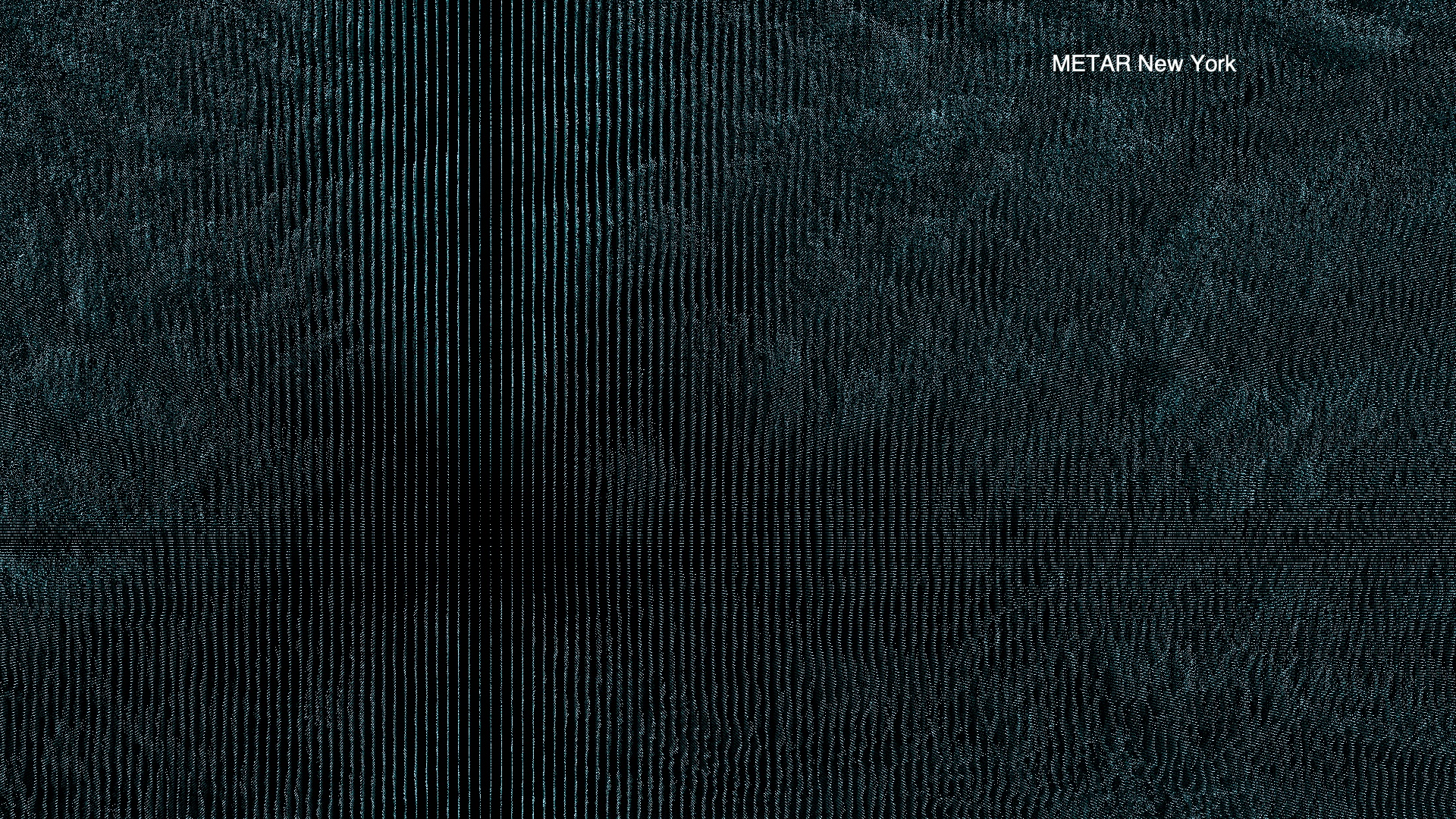
‘Solar Halo’ is a new work for live internet data in performance that explores the real time dynamics of weather systems. Using custom developed software, the project draws upon live data from sixteen atmospheric weather stations – eight across the Australian Alpine Country and eight across New York City.  Live weather data then drive an audio-visual system with which the performer interacts.

With the arrival of the internet and public data streams, new opportunities have arisen to explore the ways in which real-time (or live) data may be deployed in an art work. This recent technical development has opened the possibility of art works being responsive to live internet data, thus extending the notion of context responsive art into the datasphere so that artworks may become ‘internet enabled’.

Climate is inextricably linked to notions of the Anthropocene – an epoch in which humans have impacted global ecosystems. Given the struggle to make science heard within public discourse around climate change, there is a need to connect people to the underlying facts around climate. The creative deployment of data provides and opportunity to communicate the challenges that fragile climate systems face as a result of human activity.

The project will introduce a philosophical dimension through Timothy Morton’s notion of the ‘hyperobject’. These are large scale structures above humanity that are difficult to comprehend due to their sheer vastness. Climate change is a hyperobject, as is the internet. The project brings these two hyperobjects together to help us comprehend the apparently incomprehensible, essential in any effort to mobilise action against climate change.

Initial creative development for the work is supported by the Bogong Centre for Sound Culture via their artist residency program.

Project partners:

Experimental Intermedia Foundation, NYC USA

Bogong Centre for Sound Culture, Australia