Thanks to everyone who attended Robot Opera as part of Performance Space Liveworks Festival of Experimental Art. We got great critical feedback on the show and it was a resounding success.


music, sound, ambient media
Thanks to everyone who attended Robot Opera as part of Performance Space Liveworks Festival of Experimental Art. We got great critical feedback on the show and it was a resounding success.

We’re counting down to the opening night of Robot Opera at Bay 17 in Carriageworks in Sydney. Presented by Performance Space as part of the Liveworks Festival of Experimental Art, we have one final development week next week before it opens on October 22, running until November 1. This is a creatively and technically ambitious performance work for 8 non-humanoid robot performers which promises to be really something.
http://performancespace.com.au/events/liveworks-robot-opera/
CREATIVE TEAM
Artist Wade Marynowsky
Music and Sound Design Julian Knowles
Lighting Design Mirabelle Wouters
Dramaturgy Lee Wilson
TECHNICAL TEAM
Electrical Design Ben Nash
Programmer Imran Khan
Programmer Adam Hinshaw
You can see the whole program for the Liveworks festival below
http://issuu.com/performancespace/docs/liveworks_brochure_web_singles/1?e=2989306/30124008

I’m currently working on the music and sound design for a major new robotic performance work by Wade Marynowsky called ‘Robot Opera’. The project is funded by a Creative Australia grant from the Australia Council for the Arts. We’ve just completed a 3 week creative development period at The Red Box in Lilyfield, Sydney.

Developed in collaboration with contemporary performance group Branch Nebula, Robot Opera features eight larger than life-sized rectangular robot performers in a one hour work co-presented by Carriageworks and Performance Space at Carriageworks Bay 17 in October 2015
http://performancespace.com.au/events/robot-opera/
CREATIVE TEAM
Artist: Wade Marynowsky
Music and Sound Design: Julian Knowles
Lighting Design: Mirabelle Wouters
Dramaturgy: Lee Wilson
Electrical Design: Ben Nash
Programmer: Imran Khan
Programmer: Adam Hinshaw
You can read more about this project here
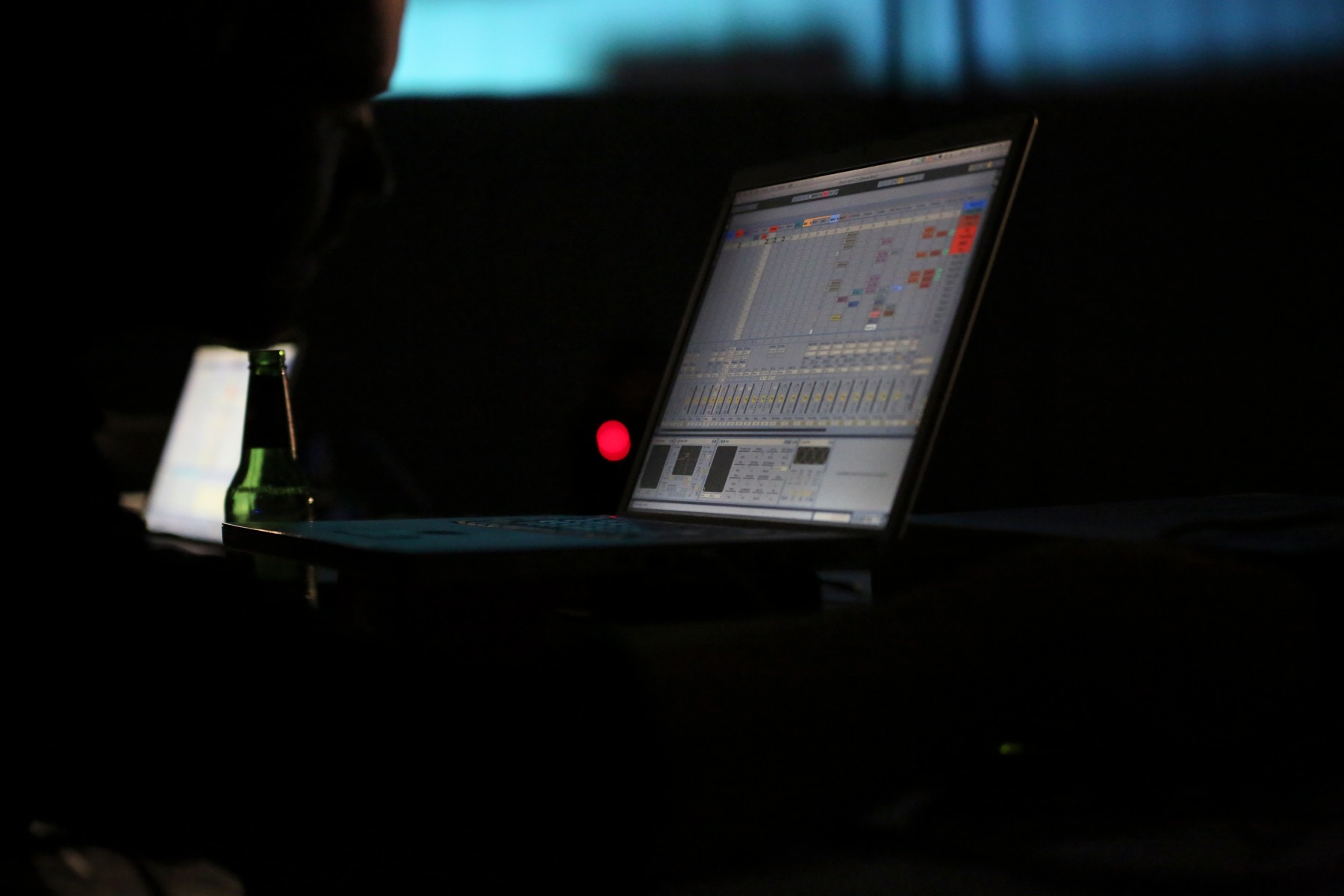
I’m currently working on programming some software processing chains for a series of responsive ambient media works. In these works sensing technologies track and respond to viewers in the space and create subtle ambient responses across three video panels.

We’ve just completed some video documentation of our mediatized performance work ‘Ghost Ships’, which we shot in the studios at Macquarie University in Sydney.
‘Ghost Ships’ is a work for wireless wearable performance interface and intelligent lighting systems. The work uses of an unencumbered wireless performance interface to drive all media elements via free air gestures from a single on stage performer. Through the use of a wearable microcontroller and sensor system designed for the project by the artists, a single performer is able to play the entire theatrical space (light, sound, video) through arm and hand gestures. This includes an intelligent moving light system that moves theatrical lights and changes light parameters in response to the performer’s gestures.
This is an evolving prototype of an interface we’ve been working on for a couple of years now. You can read about some of the R&D work here.
Software/media programming: Julian Knowles
Wearable interface design and additional programming: Donna Hewitt
Music: Julian Knowles
Performance improvisations: Donna Hewitt


I’ll be playing a show this coming Thursday night at 107 Projects in Redfern, with Hinterlandt Ensemble + Godswounds.
Date: Thursday 18 December 2014
Time: 8pm-11pm
Address: 107 Redfern St, Redfern NSW 2016
Entry: $9
I’ll be playing a set of my ambient processed guitar work, with a network of primitive analogue sound processors destroying the sound in pretty ways.
Hinterlandt Ensemble will be dedicated to an acoustic sound aesthetic. The group features Bronwyn Cumbo and Stephanie Zarka on violins, Simeon Johnson on cello, and Jochen Gutsch on acoustic guitar and trumpet. The ensemble will be performing original material composed by Jochen, brought to life by the players with their own artistic personalities.

Markus Popp in interview
Date/Time: November 14, 2013. 5.30pm
Address: Goethe-Institut Australien, 90 Ocean Street, Woollahra
Entry: Free
I am interviewing Markus Popp aka Oval this evening following his performance at the Goethe Institute in Sydney
Popp, who lives and works in Berlin, took some time between his last release under the moniker SO and the “Oh” EP because he wanted the new material to be a radical departure from his old concepts and methods on all levels, to essentially be a second “debut” album. For “O” Popp’s creative process shares nothing with his creative process for prior Oval albums. Previously, Popp focused on the creation of the programs that would process sound and effectively create the music. As a musician, Popp’s process was more theoretical in nature. Creating the platform and knowing what that platform could and should do to the sound sources. He selected the sound sources and then turned it over to the platform. For ”O”, Popp uses an instrument that is very common, a stock PC outfitted with stock sounds and plugins. He no longer uses or creates a custom platform, but instead utilizes a readily available instrument. What he has done with this instrument highlights Popp’s, perhaps for the first time, musicianship. Popp spent years woodshedding with his instrument and worked diligently to push the instrument beyond its normal sonic boundaries.

International Symposium on Electronic Art and Macrophonics present:
MACROPHONICS II
Thursday, June 13. 8pm
Bon Marche Studio, Sydney
http://www.isea2013.org/events/macrophonics-ii/
Macrophonics II presents new Australian work emerging from the leading edge of performance interface research. The program addresses the emerging dialogue between traditional media and emerging digital media, as well as dialogues across a broad range of musical traditions. Recent technological developments are causing a complete reevaluation of the relationships between media and genres in art, and Macrophonics II presents a cross-section of responses to this situation. Works in the program foreground an approach to performance that integrates sensors with novel performance control devices, and/or examine how machines can be made musical in performance. The program presents works by Australian artists Donna Hewitt, Julian Knowles, Alon Ilsar and Wade Marynowsky. From sensor-based microphones and guitars, through performance a/v, to post-rock dronescapes, movement inspired works and experimental electronica, Macrophonics II provides a broad and engaging survey of new performance approaches in mediatised environments.
Initial R&D for the work was supported by a range of institutions internationally, including the Australia Council for the Arts, Arts Queensland, STEIM (Holland) and the Nes Artist Residency (Iceland).
Curated by Julian Knowles and Donna Hewitt.
julianknowles.net
donnahewitt.net
marynowsky.net
alonilsar.com
Macrophonics video
Julian Knowles is a composer, performer, media artist and researcher specialising in new and emerging technologies. His creative work spans the fields of composition for theatre, dance, film and television, electronic music, sound design and media arts, popular music and record production. His practice-based research demonstrates a long-standing, high-level engagement with technologically-mediated music and sound practices and the relationships between audio-visual media. This has resulted in the creation of more than 50 innovative works that have been disseminated by high profile record labels, broadcasters and art institutions internationally. In the course of his career Julian has worked with many of Australia’s best-known musicians in the experimental music scene, and has been a member of the Australian electro-environmental audio group Social Interiors since the mid 1990s. As a solo artist, his music and audiovisual works have been presented at events and venues such as the San Francisco Museum of Modern Art, Experimental Intermedia (New York), What is Music?,Australian Perspecta, Liquid Architecture, the Melbourne International Film Festival and Sydney Opera House.
Donna Hewitt is a vocalist, electronic music composer and instrument designer. Her primary interest in recent years has been the investigation of new ways to interface the voice and movement with electronic media. Her work has attracted funding from the Australia Council for the Arts, most recently with all-female collective Lady Electronica. Performance highlights include: Lady Electronica Live, Queensland (2012); TES2012, Toronto, Canada; Brisbane Festival’s Under the Radar(2011); SEAM2011, Sydney; Understanding Visual Music 2011, Montréal, Canada; ICMC (USA, Ireland, UK); Liquid Architecture 7, Sydney; and The Great Escape, Sydney (2006, 2007). Donna holds a PhD in music, and is currently lecturing at the Sydney Conservatorium of Music.
Sydney-based artist Wade Marynowsky works across art and technology to develop new audience experiences. His work critiques the way in which ‘new’ media art has engaged – or failed to engage – with an audience. Forged in the artistic legacy of conceptual and performance art of the 1960s, the work is fundamentally concerned with questioning classical spectatorship and performance. His robotic / media installations combine both artificial life and live art, causing technology to perform within a system of programmed parameters that allow the work to continually unfold and evolve. His works “straddle humour, high-camp and a host of unnerving thematic orientations to absorbing effect” (Dan Rule, 2012).
Alon Ilsar is an instrument designer, electronic producer, experimental percussionist and composer. He is currently doing a practice-based research PhD at UTS in designing a new interface for electronic percussionists. He completed his Bachelor of Arts with majoring in Music and Philosophy at Sydney University and continued on to complete his Honours in Music on creative online collaboration. He has also been heavily involved in theatre include performing in Company B’s Keating! the Musical, performing as a drummer for Eddie Perfect, Meow Meow, Tim Minchin and Spontaneous Broadway, touring with Circus Monoxide as musical director, and composing and sound designing for Bondi Dreaming, In The Air, Closer, The Interview, SET and Emergence. Most recently Alon wrote, directed and performed in a choose-you-own adventure style musical game piece called The Colors Interactive Comeback Show. Other diverse projects he has been involved in include The Colors Tribute Band, Gauche, Trigger Happy, Foley, Darth Vegas, Gl;tch Jukebox, Aronas,The Renovators, The BZNZZ, Killsong, Faulkland, The Rescue Ships, Magnetic Heads, Brian Campeau, Pugsley Buzzard and The Tango Saloon.
Event Photos:


Donna Hewitt sound check. Oxygen Thief – with new wearable interface.
Event Review

“A common theme over the last seven days of ISEA2013 has been the relationship between old and new technologies. In his artist talk (part of the panel titled Nostalgia of the New, 9 June), musician/video artist Tom Ellard was emphatic that these terms old and new are essentially meaningless. He posed the provocation: does the pencil become old as soon as you stop using it? Does something become old as soon as it is out of your visual range?” Read more

Here are a few snaps of the recent Macrophonics digital workshop for Vivid Sydney at the Museum of Contemporary Art in Sydney. Donna Hewitt and I delivered a 3 hour presentation/workshop on approaches to gesture controlled audio and video.

The workshop introduced participants to the Arduino platform and various approaches to designing gestural sensing systems. Below you can see our most recent wearable interface prototype (built as part of our ongoing creative R&D with Legs on the Wall) which has been extended to include a glove based interface in addition to flex and accelerometer sensors.
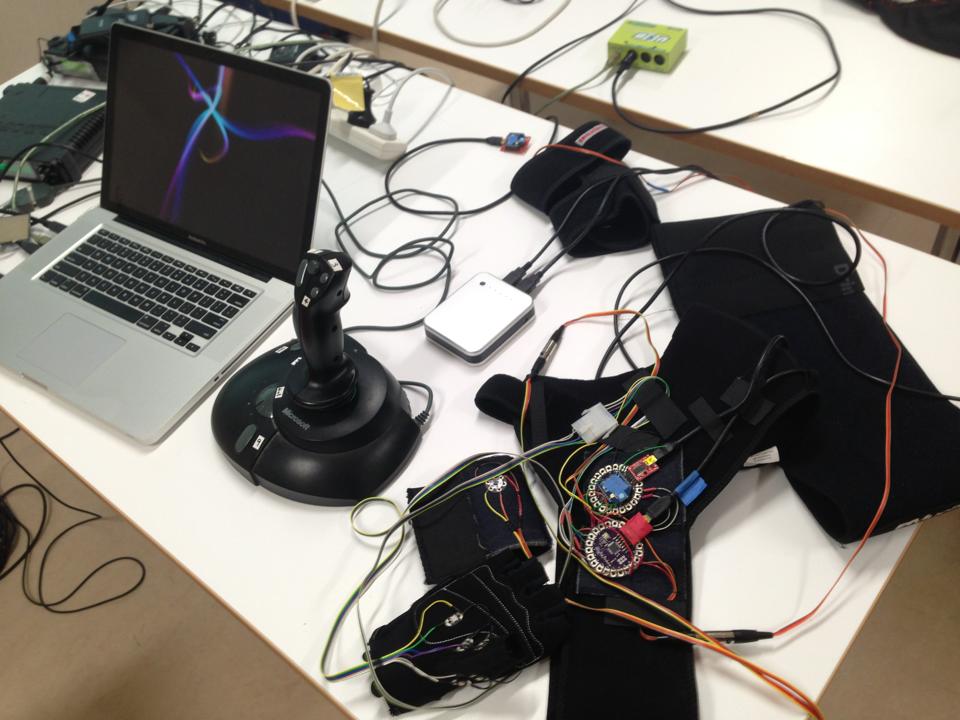
The second prototype has been designed so that it can be retrofitted to different performers of different sizes. Donna has used a neoprene and velcro system to mount sensors and provided a means to replace or change sensors via locking connectors for each sensor. The workshop also provided an opportunity to give an overview of the Max/Jitter patching environment and how gestural data was mapped in the process of achieving successful and engaging creative outcomes.
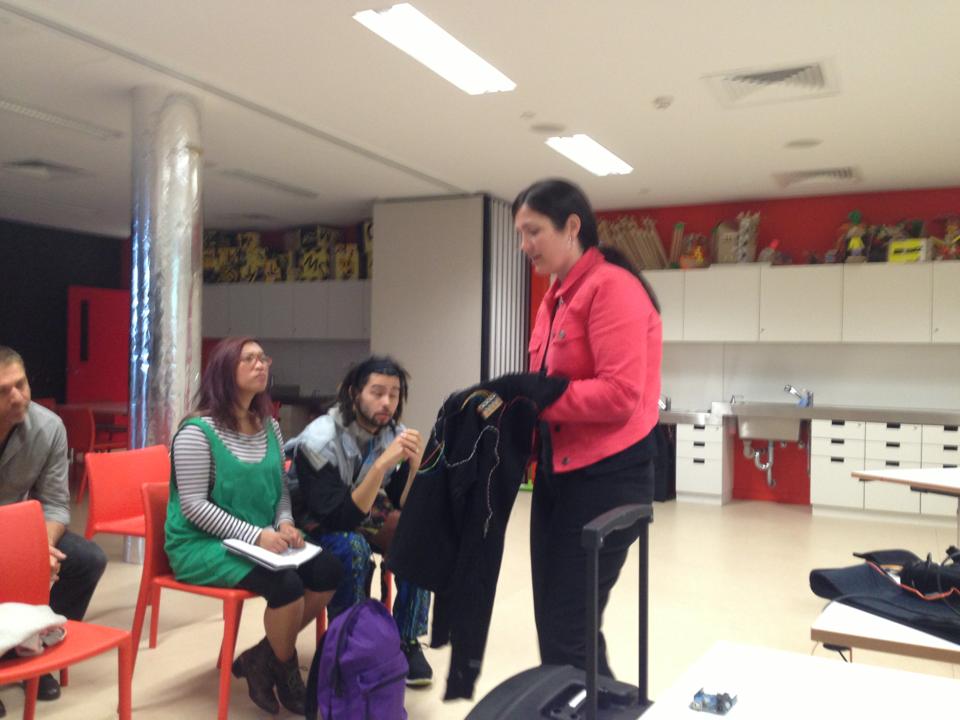
The workshop participants had a broad range of prior knowledge (from little, to quite a lot), but all seemed to get a lot out of the workshop process. And besides… it’s such a lovely building.
Here is a small video excerpt of me (captured by Jordan Dorjee) playing live at Pretty Gritty, a performance series curated by sound artist Gail Priest at 107 Projects in Sydney. I’ve been developing a new live setup and series of approaches based around processed electric guitar, tape loops, and lo-fi auto gain cassette deck audio circuits.
The video material has been incorporated into a documentary project called ‘Sampling Sydney’
http://www.youtube.com/watch?v=IRa5UDN6ZZA&list=PL08FBEDA70AFB2838&index=9
Sampling Sydney: Parts 1 and 2
Sampling Sydney: Part 3