Legs on the Wall – Open Source – putting it together

The accelerometer and wearable work progressed smoothly, without significant hitches. Donna’s wearable was completed in the final week. A few issues are worth mentioning here. She found the use of conductive thread and ribbon to be somewhat problematic. Great care needed to be exercised to prevent thread touching and shorting out (which reset the boards) and the high resistance also posed some issues. This caused Donna to make a decision to replace most of the conductive thread with conventional insulated hookup wire. Whilst initially concerned about appearance, the hookup wire actually looked great. Take a look.

Donna - showing off finished wearable with insulated wire
Donna – showing off finished wearable with insulated wire

A second issue was the total power draw of the sensors and Xbee wireless system. Donna found that the single AA battery could not supply enough power to run the system properly. With insufficient time to source and fit a higher capacity battery system before the public showing of our work, she decided to power the system from a USB cable and make the necessary modifications to the battery system following the residency.

To everyone’s surprise, when we connected the wearable to our test audio and video patches for the first time, the results were beyond our expectations. The wearable was highly responsive, ‘playable’ and Donna reported that she felt a fine sense of control over the media. She felt immersed in the media and the interface was highly intuitive, providing a rich set of possibilities for gestural control. Here is a video showing the initial hookup of the wearable interface to a test audio patch with the triaxial accelerometer and flex sensor mapped to audio filter parameters.

Macrophonics – first wearable trial

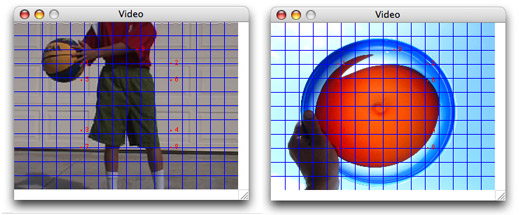
In the final week we experimented with a range of sensing techniques that picked up the position of performers on a stage. We experimented with the cv.jit and with Cyclops systems within MaxMSP. Both proved to be excellent. However given that they are video tracking systems they are inherently light dependent and so their output and behaviours are fundamentally affected by changing light states and conditions.
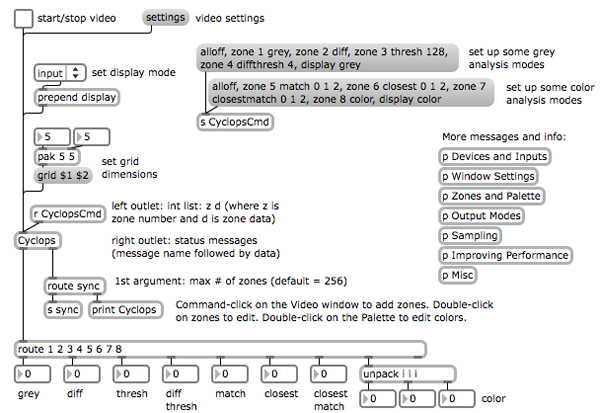
Cyclops patch detail
Cyclops grid and hotspot 'zones'
Cyclops grid and hotspot ‘zones’

All of this is manageable with precise light control and programming (or the use of infra red cameras), however in the absence of more sophisticated lighting and camera resources, we decided to use ultrasonic range finders on the stage to locate the position of performers.
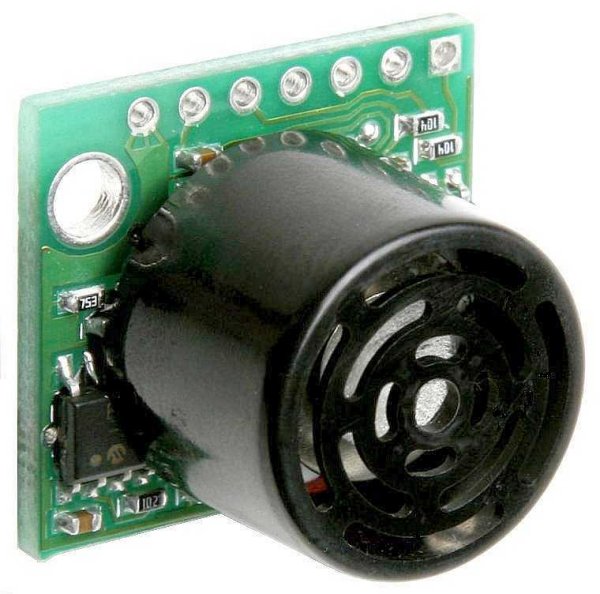
Ultrasonic rangefinder

Two of these devices were placed on either side of the stage,  outputting a stream of continuous controller data on the basis of the performer(s) proximity to the devices. These sensors were connected to Tim’s computer via an Arduino Uno. This allowed us to have a simple proximity sensing system on stage. The system was robust in respect of light, but suffered from occasional random noise/jitter that would last for a few seconds without obvious cause. This meant we had to apply heavy signal conditioning to the source data in Max/MSP to smooth out these ‘errors’ which in turn resulted in a significant amount of latency. Given these constraints, we used these sensors to drive events which did not have critical timing dependencies and could ramp in and out more gradually.

I spent a number of days in our final week programming the relationships between the sensing systems and the video elements, working with ‘retro’ 70s scanline/raster style video synth processing and time domain manipulations of quicktime movies. My computer also operated as a kind of ‘data central’, with all incoming sensor data coming in to my computer and from there being mapped/directed out to the other computers from a central patch in MaxMSP+Jitter.
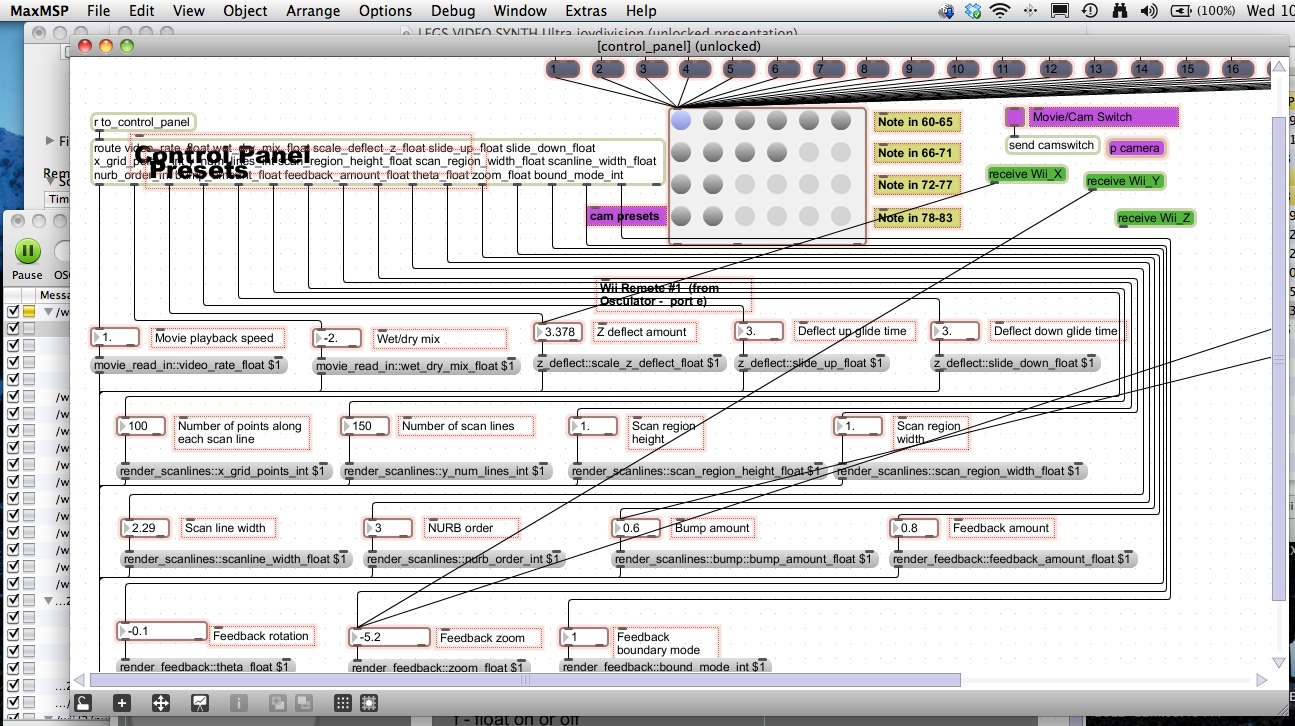
Detail of Jitter patch for Open Source residency


I’ll post some documentation of the final results once we have an edit.

Even As We Speak – FBi Radio Interview. Peel Session Preview

Even As We Speak after lunch, John Peel's House, UK 1993
Even As We Speak, John Peel’s House (‘Peel Mansions’), Stowmarket, UK 1993

Here is a recent interview and live to air performance from the studio of FBi Radio in Sydney on November 3, 2012 – immediately before our 20 year reunion gig at The Red Rattler. We speak about the experience of basing the band in the UK in the early 1990s, the independent scene at that time and the experience of working with John Peel. The show previews two previously unreleased tracks  ‘Falling Down the Stairs (ft. Younger Youth)’ and ‘Best Kept Secret’ recorded for the BBC in 1993, and soon to be released on the forthcoming Even As We Speak Peel/Goodier sessions release ‘Yellow Food’. We also play a stripped back in-studio live version of a further unreleased Peel Session track ‘Everywhere I Go’.


BBC Maida Vale UK Peel Session 1993-1
Even As We Speak. BBC Maida Vale UK. Peel Session 1993


BBC Maida Vale UK Peel Session 1993-3
Even As We Speak at BBC Maida Vale UK. Peel Session 1993


BBC Maida Vale UK Peel Session 1993-4
Even As We Speak at BBC Maida Vale. Peel Session 1993


BBC Maida Vale UK Peel Session 1993-5
Even As We Speak at BBC Maida Vale. Peel Session 1993. Tympani overdubs ‘Best Kept Secret’


BBC Maida Vale Studio 4. Home of Peel Sessions. Main live room 2011


Even As We Speak live at The Red Rattler. Sydney Nov 3, 2012

To celebrate the imminent release of our John Peel and Mark Goodier BBC Sessions, Even As We Speak played a special one-off show at The Red Rattler Theatre in Sydney Australia on November 3.

Even As We Speak – Live at The Red Rattler, Sydney Australia. Nov 3, 2012

This marked the first time the band had played together since 1993 when we returned to the Australia from the UK, following the release of our final ‘Blue Eyes Deceiving Me‘ EP on the legendary Bristol/UK label Sarah Records.


http://www.youtube.com/watch?v=of-KfBFsUiI


Joined by supports Alannah Russack (ex The Hummingbirds), and Living with Robert, the night brought out a bunch of die hard fans, with people even taking international flights to get to the show. Now that’s serious dedication…

Mary Wyer, Matt Love and I did an interview for FBi Radio the afternoon before the show. We talked about the experience of recording sessions for John Peel and previewed two of the tracks from the impending release. We also did a seat-of-the-pants live to air from the radio studio of the otherwise unreleased Peel Session song ‘Everywhere I Go’. Stay tuned for updates on this brand new release, which should be announced in the next fortnight or so, as soon as contracts are finalised with the BBC.

Even as We Speak. Live at the Red Rattler. Sydney Australia. Nov 3, 2012.

The Waiting Room, Brisbane Nov 22, 2012

The Waiting Room - Nov 22, 2012


Hinterland + Anonymeye + Julian Knowles + Puzhaki

Join us at The Waiting Room in Brisbane’s West End for this diverse show featuring artists from Sydney, Brisbane, and the Gold Coast. Don’t miss how four men use four different approaches to create a million unusual sounds – all in one Thursday night.

HINTERLANDT is a Sydney-based solo act juggling numerous instruments, sounds and influences. Hinterlandt has toured internationally and released truckloads of material. In his first-ever Brisbane show, Hinterlandt mastermind Jochen Gutsch presents his brand new album “Cartography” on Laughing Outlaw Records.

Info: http://www.hinterlandt.net/

Listen: http://soundcloud.com/hinterland

ANONYMEYE is the nom de musique of Andrew Tuttle. Anonymeye reconfigures various organic and mechanic musics within a sonic framework akin to an abstract musical Esperanto. Utilising electronic and acoustic instrumentation including acoustic guitar, computer, banjo, and synthesiser, Anonymeye straddles and blurs boundaries between improvisation and composition, experimentation and song-form, and melody and dissonance.

Info: http://www.anonymeye.com/
Listen: http://anonymeye.bandcamp.com/

JULIAN KNOWLES has been creating pretty, ambient electronic noise for 20 years as a solo artist and with the iconic field recording group, Social Interiors. His work crosses every musical boundary possible – experimental, post-rock, ambient, field – and is fuelled by destroyed analog media, guitars and laptops.

Info: http://www.julianknowles.net/

PUZAHKI is the alias of Gold Coast based electronic music producer Craig Parry. Puzahki’s preceding reputation lies in breakcore & jungle however his current musical focus is instrumental hiphop and abstract turntablism. He has just released a 7 track EP titled Emergency Exit, has a full length mix album coming out on Ender Records and is about to self release a 3 track split single with Chupi.

Info: http://puzahki.net/

THE WAITING ROOM is a community-minded DIY music and arts space located at 11 Browning Street, West End, Brisbane.

https://www.facebook.com/WaitingRoomBrisbane

Julian Knowles. Live. The Waiting Room Brisbane. Image: Craig Parry


Legs On the Wall – Open Source residency

Legs On The Wall


http://youtu.be/LlsILg_usOo


I’ve just been advised that our Macrophonics collective will be one of two artist groups in residence at Legs On The Wall in Sydney in Nov/Dec 2012 as part of their Open Source program.

Legs On the Wall - Open Source program
Legs On the Wall – Open Source program

This project is supported by the Australia Council for the Arts and provides and opportunity for artists working with media technologies to undertake a month long residency with the company to explore  an aspect of  digital media in theatre/performance contexts.

The group proposes that for Open Source we build on the work and momentum of Macrophonics in 2011 by establishing a group collaboration framework to explore the use of sensing technologies and instruments in a theatrical context. Each artist brings a different skill set and, in combination, they represent an extremely broad capability across sound and visual media technologies and physical computing. Much of our work to date has focused on sensing in an ‘instrumental music’ fashion, drawing upon music models for performer/technological interaction. In this project we would examine the ways in which we could work with live theatre performers as agents within a multi-performer sensing project.  Video tracking, position, distance and touch sensors would be used to create a responsive space for performance. The performance space would output data as a result of the performer’s movement and this data would be drawn upon by the Macrophonics team to create a responsive sound and media scape. The objective would be to augment the expressive range of the theatre performer by situating them in a responsive environment. Specifically to explore and define new direct relationships between the theatre performers, musicians and media artists who traditionally work with a network of indirect or interpretive relationships with one another.

Read more about this project here.