Legs on the Wall – Open Source residency begins

The Red Box/Legs on the Wall, Sydney

The Macrophonics artist collective (Julian Knowles, Donna Hewitt, Wade Marynowsky, Tim Bruniges) has just commenced our Open Source media technologies residency with Sydney based physical theatre company Legs on the Wall at their Red Box development space. Background information on the project can be found here.
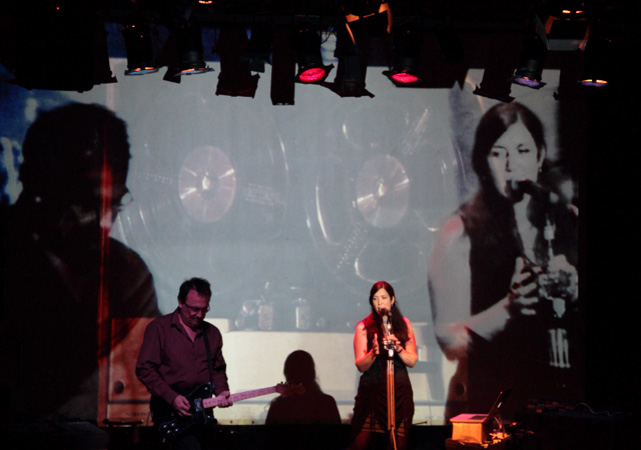
Macrophonics live – Brisbane Festival 2011

The residency sees the group examine a range of interface technologies and approaches to explore the nexus between theatrical performers and a four member live media ensemble. The objective is to build a responsive performance environment that will allow the theatre performers to have direct gestural input into the media control system, defining new relationships between the performance ensemble, the media design elements and the media ensemble.

We’ve broadly structured our investigation across two approaches. The first is video tracking/computer vision techniques (using the cv.jit suite of objects for Jitter) where the stage area can be analysed and moving objects tracked.
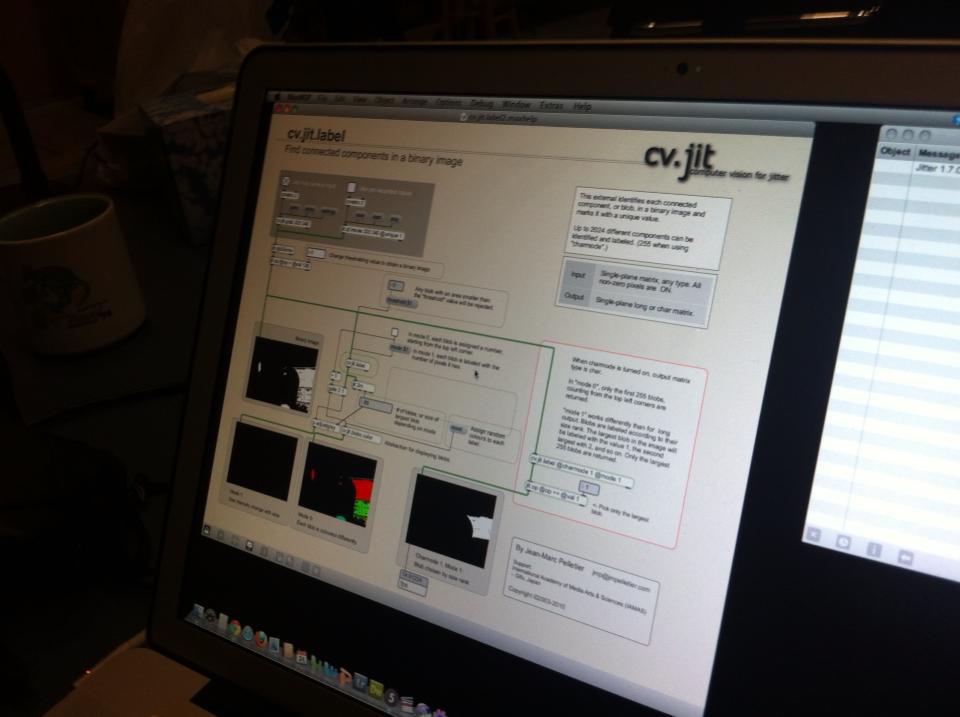
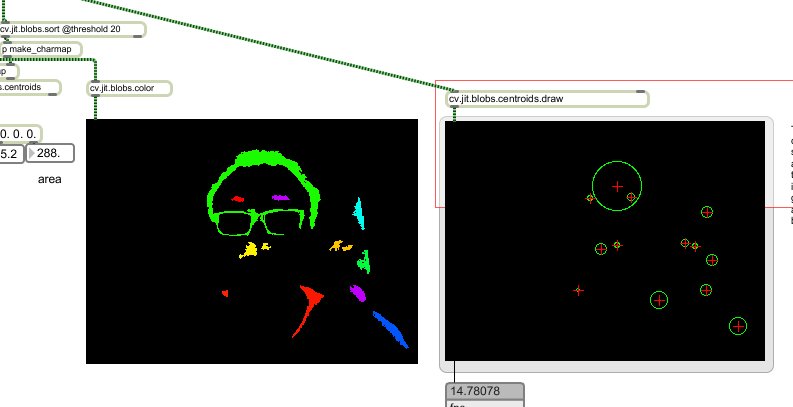
Jitter patch – cv.jit suite of ‘computer vision’ (video analysis) objects
Moving masses in the video frame are identified and then tracked

The second area of investigation is wearable garment interfaces that sense movement directly at each performer (accelerometers, pressure and flex sensors, light sensors etc) and send data wirelessly to the media ensemble. We are using the LilyPad Arduino platform for this work. The LilyPad is a small, flat implementation of the Arduino platform that can be sewn into garments. Conductive ‘thread’ can then be sewn in ‘tracks’ into the garment to form the links between the device and the attached sensors.
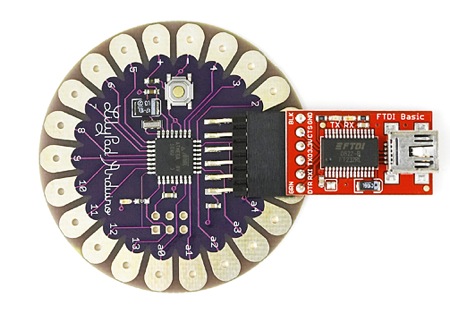
LilyPad Arduino

The LilyPad can be run from a battery source and can, with a bit of extra stuff, transmit data wirelessly over an ad hoc wireless network.
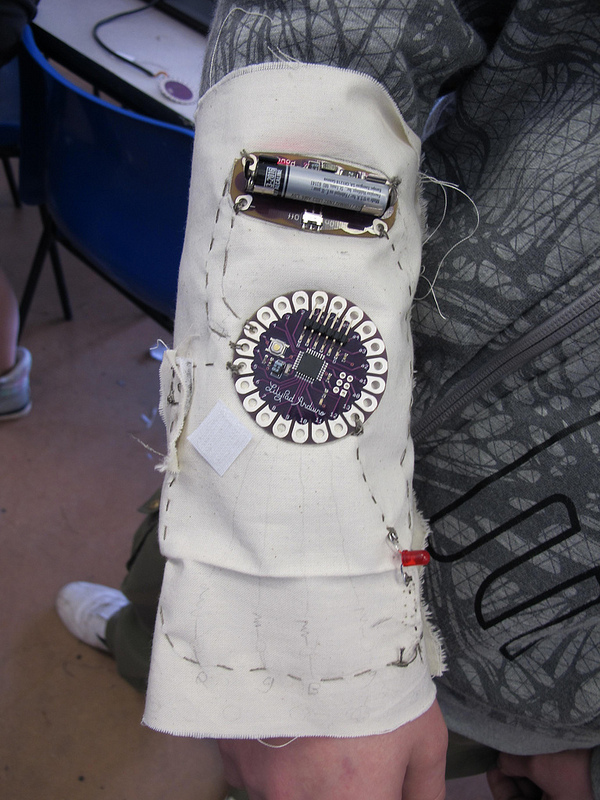
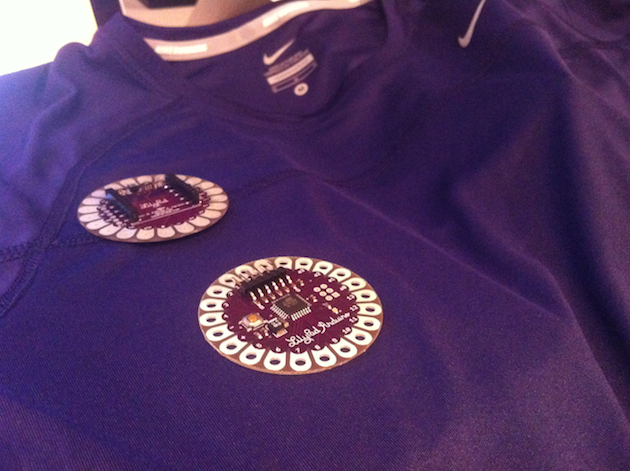
Lilypad arduino sewn into garment with conductive thread. Image credit: Rain Rabbit (flickr)
Donna’s LilyPad – ready for sewing

The Waiting Room, Brisbane Nov 22, 2012

The Waiting Room - Nov 22, 2012


Hinterland + Anonymeye + Julian Knowles + Puzhaki

Join us at The Waiting Room in Brisbane’s West End for this diverse show featuring artists from Sydney, Brisbane, and the Gold Coast. Don’t miss how four men use four different approaches to create a million unusual sounds – all in one Thursday night.

HINTERLANDT is a Sydney-based solo act juggling numerous instruments, sounds and influences. Hinterlandt has toured internationally and released truckloads of material. In his first-ever Brisbane show, Hinterlandt mastermind Jochen Gutsch presents his brand new album “Cartography” on Laughing Outlaw Records.

Info: http://www.hinterlandt.net/

Listen: http://soundcloud.com/hinterland

ANONYMEYE is the nom de musique of Andrew Tuttle. Anonymeye reconfigures various organic and mechanic musics within a sonic framework akin to an abstract musical Esperanto. Utilising electronic and acoustic instrumentation including acoustic guitar, computer, banjo, and synthesiser, Anonymeye straddles and blurs boundaries between improvisation and composition, experimentation and song-form, and melody and dissonance.

Info: http://www.anonymeye.com/
Listen: http://anonymeye.bandcamp.com/

JULIAN KNOWLES has been creating pretty, ambient electronic noise for 20 years as a solo artist and with the iconic field recording group, Social Interiors. His work crosses every musical boundary possible – experimental, post-rock, ambient, field – and is fuelled by destroyed analog media, guitars and laptops.

Info: http://www.julianknowles.net/

PUZAHKI is the alias of Gold Coast based electronic music producer Craig Parry. Puzahki’s preceding reputation lies in breakcore & jungle however his current musical focus is instrumental hiphop and abstract turntablism. He has just released a 7 track EP titled Emergency Exit, has a full length mix album coming out on Ender Records and is about to self release a 3 track split single with Chupi.

Info: http://puzahki.net/

THE WAITING ROOM is a community-minded DIY music and arts space located at 11 Browning Street, West End, Brisbane.

https://www.facebook.com/WaitingRoomBrisbane

Julian Knowles. Live. The Waiting Room Brisbane. Image: Craig Parry


The Flashcard Sequences Part 1

Just presented the first performance of  The Flashcard Sequences Part 1: Amsterdam 14.12.10 last night. I’ve uploaded a copy to Vimeo. Switch to High Definition and view in full screen for the full experience.


Since mobile phone video has been improving at such an alarming rate, I’ve renewed my interest in field/environmental a/v work, which was a strong focus for me through the 1990s, both in my solo work and with the group Social Interiors. I’ve found myself capturing moments or locations from the every day or my travels and have started making a series of short works based on these moments in time and place. The focus is on capturing the moment or a perspective with very modest means – nothing but a tiny hand held iphone. There are challenges, such as image stability due to lack of tripod and, as will be seen in the first work, clumsy/cold hands in the snow. I have tried to work with these instabilities as an aesthetic element and make them feel part of the work.

The Flashcard Sequences has thus made its way into the world.

The Flashcard Sequences comprises a series of short semi-improvisatory works produced with handheld mobile phone video and portable laptop production technologies. The production process is intentionally swift and the works are produced (often in hotel rooms) as quickly as possible following the image capture. These pieces function as snapshots which attempt to capture an underlying essence of a moment or place.

Amsterdam 14.12.10 is the first piece in the series, and was created during a residency at STEIM, Holland in December 2010. The harsh European winter of 2010/11 gave rise to heavy snowfalls, closing roads and bringing many essential transport services to a halt. The visual material consists of a series of static video shots containing patterns of snow falling from the sky. In this piece, the video source is digitally analysed and used to affect processing parameters in the audio domain. Such an approach attempts to find, and compositionally engage with, the direct structural relationships between the visual and sound materials whilst stopping short of direct and literal sonification. Such an approach aims to take transductive visual/sound mapping processes and bring them into creative dialogue with freely interpretive compositional processes.

You can read more about this work here.

 The development of  The Flashcard Sequences has been supported by the Australia Council for the Arts, Arts QLD and STEIM (Holland)


Legs On the Wall – Open Source residency

Legs On The Wall


http://youtu.be/LlsILg_usOo


I’ve just been advised that our Macrophonics collective will be one of two artist groups in residence at Legs On The Wall in Sydney in Nov/Dec 2012 as part of their Open Source program.

Legs On the Wall - Open Source program
Legs On the Wall – Open Source program

This project is supported by the Australia Council for the Arts and provides and opportunity for artists working with media technologies to undertake a month long residency with the company to explore  an aspect of  digital media in theatre/performance contexts.

The group proposes that for Open Source we build on the work and momentum of Macrophonics in 2011 by establishing a group collaboration framework to explore the use of sensing technologies and instruments in a theatrical context. Each artist brings a different skill set and, in combination, they represent an extremely broad capability across sound and visual media technologies and physical computing. Much of our work to date has focused on sensing in an ‘instrumental music’ fashion, drawing upon music models for performer/technological interaction. In this project we would examine the ways in which we could work with live theatre performers as agents within a multi-performer sensing project.  Video tracking, position, distance and touch sensors would be used to create a responsive space for performance. The performance space would output data as a result of the performer’s movement and this data would be drawn upon by the Macrophonics team to create a responsive sound and media scape. The objective would be to augment the expressive range of the theatre performer by situating them in a responsive environment. Specifically to explore and define new direct relationships between the theatre performers, musicians and media artists who traditionally work with a network of indirect or interpretive relationships with one another.

Read more about this project here.